# JPYD, JASMY and JasmyChain: Is the Bigger Jasmy Ecosystem Finally Taking Shape?
Updated: Aug 13
For years, Jasmy investors have been waiting for one crucial development: a clearer explanation of how JASMY itself fits into the commercial ecosystem Jasmy is building.
Jasmy has developed technology around personal data, digital identity, enterprise applications and blockchain infrastructure. JasmyChain has now added another piece to that architecture.
But one particularly intriguing piece has remained unresolved:
JPYD.
Until recently, much of the discussion surrounding JPYD was speculative. Jasmy owned the JPYD trademark, but that alone did not tell us whether JPYD would become a stablecoin, who would issue it, where it would operate or what role JASMY would play.
The picture is now becoming considerably more interesting.

First: what is JPYD?
JPYD is being developed as a Japanese yen-denominated stablecoin, designed so that:
1 JPYD ≈ ¥1
Unlike JASMY, whose market price can rise and fall, a stablecoin is designed to maintain a stable value.
That makes the two assets potentially useful for very different purposes.
JPYD could function as digital money.
JASMY could function as the utility asset powering the infrastructure around that money.
And that distinction could prove extremely important.
The Harada statement changes the conversation
The biggest development is a public statement from Hiroshi Harada, indicating that:
“$JASMY will serve as the base currency for corporate token issuance and $JPYD (stablecoin).”
That is much more significant than simply saying that JPYD and Jasmy are associated.
It suggests that JASMY has an intended economic role within the JPYD ecosystem.
Until now, one of the biggest questions surrounding Jasmy has been:
Why does enterprise adoption necessarily create demand for the JASMY token?
A company could theoretically use Jasmy technology without the value flowing through to JASMY holders.
But if JASMY becomes a base asset supporting stablecoins and enterprise token issuance, the relationship between the technology and the token becomes potentially much stronger.
Then there is JasmyChain
This is where the pieces begin fitting together.
JasmyChain has moved to mainnet, and JASMY is used as its gas token.
Gas is essentially the blockchain resource required to execute transactions.
So imagine an enterprise application running on JasmyChain.
A customer might pay:
¥10,000
using a yen-denominated stablecoin such as JPYD.
The customer does not need to worry about the price of JASMY. They simply see ¥10,000.
Behind the scenes, however, the blockchain transaction may require JASMY to execute the transaction.
Conceptually:
Customer → JPYD → enterprise application → JasmyChain → JASMY
That is potentially much more powerful than asking consumers to purchase JASMY simply to make everyday payments.
JPYD provides the stable money.
JASMY provides the blockchain utility.
And JPYD now publicly identifies Jasmy
There is another development that strengthens the relationship.
The JPYD project website now includes Jasmy within its ecosystem/partner presentation.
That matters because previously the connection was largely inferred from things such as Jasmy's ownership of the JPYD trademark.
We now have multiple pieces pointing in the same direction:

That's a substantially more developed picture than we had previously.
But one critical link is still missing
This is where we need to distinguish what looks likely from what has actually been confirmed.
We do not yet have definitive confirmation that every JPYD transaction will occur on JasmyChain and consume JASMY.
That would be the major technical confirmation. What we want to see is documentation establishing something like:
JPYD transaction → JasmyChain → JASMY gas
If that architecture is confirmed, JPYD activity could potentially create recurring network demand for JASMY.
And that is very different from speculative demand for the token.
Why recurring demand matters
Suppose JASMY rises because traders suddenly become interested in it.
People buy.
The price rises.
Eventually some traders sell.
That demand can disappear as quickly as it appeared.
Now imagine instead that thousands of businesses use infrastructure requiring JASMY.
Every day there are:
payments,
identity transactions,
enterprise tokens,
data exchanges,
IoT transactions,
stablecoin settlements,
smart-contract executions.
If those activities require JASMY, demand is being generated by usage of the network, rather than solely by investors buying the token.
Scale that from thousands of transactions to millions—or potentially billions of machine-to-machine transactions—and the economics become very different.
That's why the JPYD architecture matters so much.
Why wouldn't businesses simply use JASMY?
Because businesses generally don't want their everyday money fluctuating dramatically.
Imagine a company owes a supplier ¥1 million.
It wants to know that the digital asset it sends tomorrow will still represent approximately ¥1 million.
JPYD could provide that stability.
JASMY can perform another job entirely: powering the infrastructure underneath the transaction.
There is a familiar analogy.
When you use an application on the internet, you don't purchase computing power from the server every time you press a button.
You interact with the service.
The infrastructure operates underneath it.
JPYD could become part of the user-facing financial layer while JASMY operates deeper within the infrastructure.
Corporate tokenisation could be even bigger
Harada's reference to corporate token issuance should not be overlooked.
Imagine companies being able to create:
loyalty tokens,
reward points,
digital memberships,
tokenised assets,
employee incentives,
customer rewards,
machine-payment systems.
JPYD could provide a stable settlement asset.
Jasmy's identity technology could establish who is participating.
The Personal Data Locker could control what information is shared.
JasmyChain could provide the blockchain infrastructure.
And JASMY could provide the network utility.
That starts looking less like an individual cryptocurrency project and more like a digital economic infrastructure stack.
Where does Remixpoint fit?
This is another reason the situation deserves attention.
Remixpoint has been expanding its strategy beyond simply holding Bitcoin.
Its direction increasingly involves:
enterprise digital assets,
corporate wallets,
tokenisation,
Web3,
deep technology,
digital asset treasury strategies.
And Hiroshi Harada sits at an unusual intersection between the Jasmy and Remixpoint ecosystems.
That does not establish a Remixpoint–Jasmy commercial partnership.
But it makes developments involving enterprise tokenisation, stablecoins and corporate digital assets particularly interesting to watch.
The missing event remains a formal commercial relationship between the companies.
If that occurs, the implications would need to be assessed separately.
What hasn't happened yet?
There are still several important pieces we should not treat as confirmed.
JPYD has not yet been officially launched into full production.
We still need clarity regarding:
the legally responsible issuer,
Japanese regulatory arrangements,
banking and reserve arrangements,
the blockchain deployment,
the JPYD smart-contract address,
and exactly how JASMY interacts with JPYD transactions.
These aren't minor details.
They determine whether JPYD becomes a genuinely important source of utility for JASMY or simply another product associated with the broader ecosystem.
The announcement I'm waiting for
The strongest possible confirmation would effectively say:
JPYD is now live, issued through an appropriately regulated Japanese entity, deployed on JasmyChain, with JASMY required for network transactions.
That would connect:
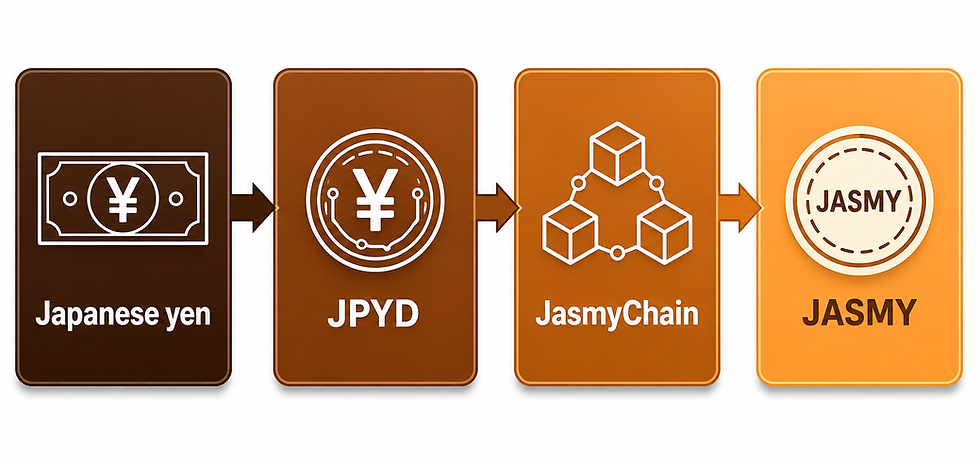
And if enterprises were simultaneously adopting the infrastructure, the final piece would be:
real transaction volume.
That is when the discussion moves away from what Jasmy could become and towards measuring what the ecosystem is actually doing.
The bigger picture
The interesting thing about JPYD isn't simply the creation of another Japanese stablecoin.
Japan can have multiple stablecoins.
JPYC can exist.
Banks can issue their own stablecoins.
JPYD can exist alongside them.
The important question is what ecosystem each stablecoin serves.
JPYD could potentially become the stable monetary layer within Jasmy's enterprise ecosystem, while JASMY powers the blockchain infrastructure underneath it.
If that architecture is confirmed, the relationship could look something like:
Identity → Personal Data Locker → enterprise applications → JPYD → JasmyChain → JASMY
That would finally provide something Jasmy investors have been waiting years to see:
a clearer bridge between real-world adoption of Jasmy technology and economic utility for the JASMY token.
We aren't at the end of that story yet.
But compared with the days when JPYD was little more than an intriguing trademark, the pieces are beginning to form a much more coherent picture.
And the next announcements; particularly the issuer, regulatory structure, mainnet deployment and JASMY transaction mechanics, could tell us whether that picture becomes reality.


Comments