JasmyChain Suddenly Springs to Life: A Burst of On-Chain Activity Appears
Updated: Sep 5
Something interesting is happening on JasmyChain tonight (I'm in Australia).
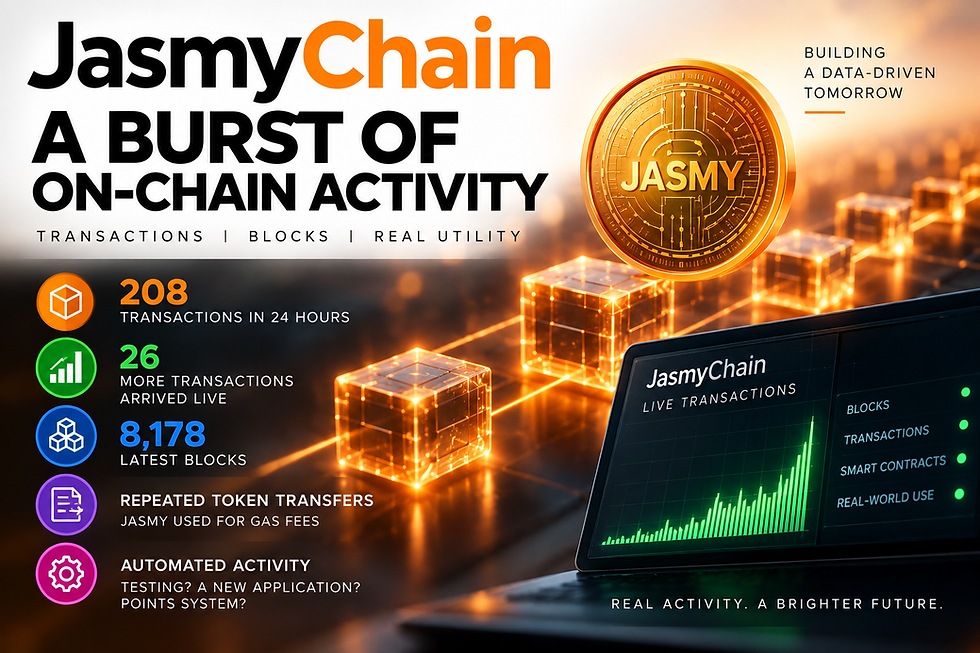
On 4 September 2026, live data from the JasmyChain explorer began showing a noticeable acceleration in blockchain activity. After a long period in which JasmyChain has remained relatively quiet, blocks and transactions began appearing in rapid succession.
This does not yet prove mass adoption or a major product launch, but the change is significant enough to warrant attention.
What happened?
At approximately 11:02 pm AEST on 4 September, JasmyScan displayed:
3,590 transactions over the previous 24 hours
1,275 total addresses on the explorer shortly beforehand
Blocks reaching approximately 8,373
New blocks appearing within seconds during the observation
Repeated successful token transfers
Tiny amounts of JASMY being paid as transaction fees
This is a substantial change from the very low level of JasmyChain activity we have been monitoring previously.
So what are all these transactions?
Looking more closely reveals an important pattern.
Many of the new blocks appear to contain two transactions.
One is labelled:
Contract call — startBlock — ArbOS
The other is labelled:
Token transfer
The startBlock transactions shouldn't be interpreted as individual users suddenly arriving on JasmyChain.
JasmyChain is built using Arbitrum technology, and ArbOS is part of the underlying L2 infrastructure. These startBlock calls are system-level activity associated with processing blocks.
The more interesting transactions are the token transfers occurring alongside them.
The token transfers are the part to watch
The transfers visible during tonight's activity repeatedly showed the same general pattern:
From: 0xC5...Efa8
To/contract: 0xf0...bEE8
Method: 0x0efe6a8b
JASMY value transferred: 0
JASMY transaction fee: approximately 0.0000006 JASMY in the examples observed.
The fact that "Value JASMY" is zero can initially look confusing.
It does not mean nothing is being transferred.
A token can be moved or a token contract can be executed without native JASMY itself being the asset transferred. JASMY is instead being used to pay the network gas fee.
That is an important distinction.
What could be happening?
The repetitive nature of the transactions suggests this is probably automated activity rather than hundreds of individual people manually making transactions.
Possible explanations include:
testing of a new or existing application
automated token distribution
points or reward processing
smart-contract testing
a batch operation
an application beginning to generate transactions
infrastructure or deployment activity
We don't yet have enough evidence to say which explanation is correct.
That distinction matters.
Seeing hundreds of transactions is exciting, but transaction count alone does not equal hundreds of new users.
One application can generate hundreds or thousands of blockchain transactions automatically.
Why this is still positive for Jasmy
Even if this turns out to be automated testing, there is something important happening.
JasmyChain exists to be used.
For a long time, one of the biggest questions surrounding the network has been when we would begin seeing meaningful applications and activity appearing on-chain.
Tonight we can actually observe:
contracts executing
tokens moving
blocks being processed
JASMY being consumed for transaction fees
That is real network activity.
And this highlights one of the most interesting aspects of JasmyChain's design.
JASMY has a functional role on the network
JASMY isn't merely sitting alongside JasmyChain as a tradable cryptocurrency.
It is the network's native gas token.
When applications execute transactions on JasmyChain, small amounts of JASMY can be required to pay the transaction fees.
The amounts currently being consumed are tiny. Nobody should suggest this activity is materially affecting JASMY's supply or price.
But conceptually, this is important.
If JasmyChain eventually supports many applications producing large numbers of transactions, those applications create utility-driven demand for JASMY gas.
Tonight's activity provides a small real-world demonstration of that mechanism.
And this comes at an interesting time
We've already been watching new activity emerge within the broader JasmyChain ecosystem, including points/token experimentation and increasing smart-contract deployment.
That makes tonight's sudden burst particularly worth investigating.
The key question now isn't simply:
"How many transactions are there?"
It is:
"What application or contract is generating them?"
Identifying the contract behind 0xf0...bEE8 and decoding method 0x0efe6a8b should help establish exactly what process is running.
Bottom line
Something has clearly changed on JasmyChain tonight.
The evidence currently supports saying that JasmyChain experienced a sudden burst of automated on-chain activity on 4 September 2026, including repeated token transfers accompanied by rapid block processing.
It does not yet support claims that hundreds of new users have arrived or that a new Jasmy product has officially launched.
But after watching a relatively quiet network for months, seeing contracts repeatedly execute and tokens move across JasmyChain is certainly something worth paying attention to.
The network is doing something.
Now we need to identify what is doing it; and why.
Either way, the timing couldn't be better!


Comments