Japan Is Betting on AI and Robotics. Could Jasmy Be Building Part of the Infrastructure?
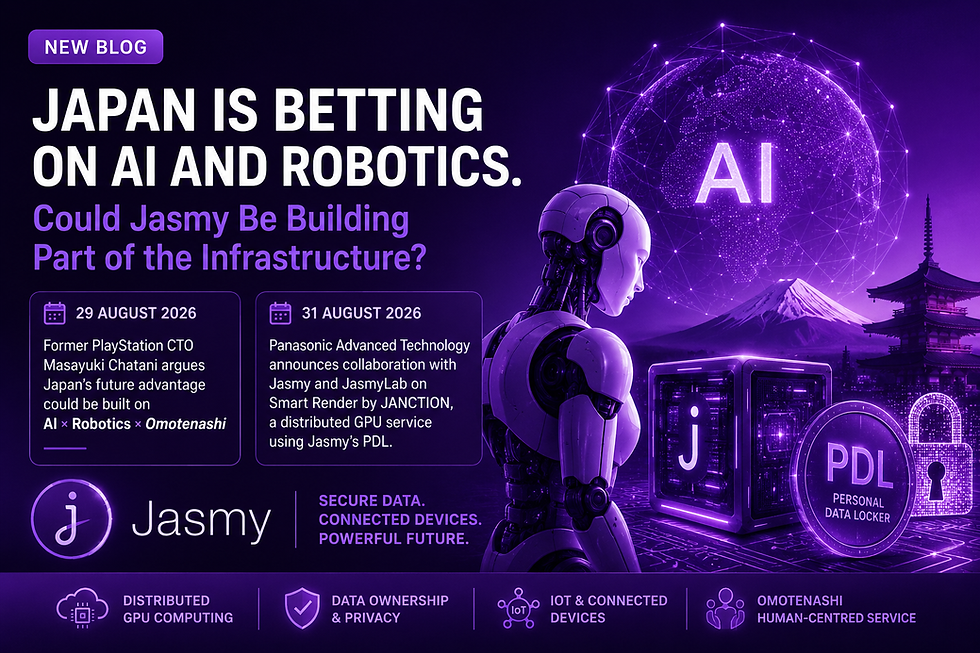
On 29 August 2026, DEEPPOINT published an article featuring former PlayStation CTO Masayuki Chatani discussing the rapid acceleration of artificial intelligence and Japan’s potential advantage in combining AI, robotics and omotenashi, Japan’s distinctive approach to human-centred service.
Then, on 31 August 2026, Panasonic Advanced Technology announced that it had begun working with Jasmy and JasmyLab toward providing Smart Render by JANCTION, a distributed GPU service incorporating Jasmy’s Personal Data Locker technology.
These two developments are not officially connected.
However, they appeared within days of each other and point toward an interesting bigger picture.
Japan is increasingly considering how AI can move beyond computers and into machines, robots and physical services.
At the same time, Jasmy is building technology around some of the infrastructure that this future could require: secure data, IoT devices and distributed computing power.
29 August 2026: Former PlayStation CTO discusses Japan’s AI future
Masayuki Chatani is a significant figure in Japanese technology.
He was involved with the original PlayStation and subsequently served as CTO and Executive Vice President of Sony Computer Entertainment.
In the article published by DEEPPOINT on 29 August, Chatani discusses the technological “singularity”, traditionally associated with around 2045.
His view is that the extraordinary acceleration of generative AI means this point could arrive considerably sooner.
But his argument about Japan is arguably more interesting.
Chatani believes Japan has an opportunity to combine three strengths:
Artificial intelligence
Robotics
Omotenashi, or highly attentive human-centred service
The idea is relatively simple.
AI provides intelligence.
Robotics gives that intelligence the ability to interact with the physical world.
Human-centred service determines how that technology is actually used to improve people’s lives.
Why Japan’s ageing population matters
Japan has one of the world’s most advanced ageing populations.
Normally, this is discussed as an economic problem.
Chatani also sees an opportunity.
Japan needs new ways of helping an ageing population maintain independence and quality of life while dealing with a shrinking workforce.
AI-powered robotics could potentially assist with areas such as:
Aged care
Mobility
Household assistance
Transportation
Communication
Monitoring
Service industries
Japan therefore has an enormous real-world environment in which these technologies could be developed and refined.
If successful, similar systems could eventually be exported to other countries as their populations age.
Where does Jasmy fit into this?
This is where we need to be very clear.
There is no confirmed connection between Chatani’s article and Jasmy.
Chatani was not announcing a Jasmy partnership.
There is no evidence that his comments were referring specifically to Jasmy.
However, the technological future he describes creates a problem that is directly relevant to Jasmy.
AI-powered machines need data.
Lots of it.
Think about an AI-powered care robot
Imagine a robot assisting an elderly person in their home.
To provide genuinely useful assistance, that system could potentially need access to information such as:
Identity
Preferences
Daily routines
Voice commands
Location
Movement
Behaviour
Access permissions
Interaction history
The robot could also be communicating with other devices and services.
That creates an important question.
Who controls all that data?
There are also questions about who can access it, how permission is provided and how sensitive information can be securely shared between different systems.
This is where Jasmy’s technology becomes relevant.
Jasmy’s original focus is data
Jasmy has spent years developing technology around IoT and the management of data generated by people and connected devices.
One of its core technologies is the Personal Data Locker, or PDL.
The concept is designed to give individuals greater control over their own information rather than simply allowing companies and platforms to control it.
That potentially becomes increasingly important as AI moves into the physical world.
A world containing millions of intelligent machines does not simply need better AI.
It needs secure infrastructure underneath the AI.
Then something important happened on 31 August
Only two days after the DEEPPOINT article appeared, Panasonic Advanced Technology announced a new development involving Jasmy and JasmyLab.
On 31 August 2026, the companies announced that they had begun working toward providing Smart Render by JANCTION.
Smart Render uses distributed GPU resources rather than relying entirely on one central computing environment.
The announcement brings together:
Panasonic Advanced Technology’s software and systems expertise
Jasmy’s platform and Personal Data Locker technology
JasmyLab and JANCTION’s distributed GPU infrastructure
This is significant because GPUs are one of the fundamental computing resources required by modern artificial intelligence.
And it isn't necessarily just about rendering
The initial Smart Render application focuses on demanding rendering workloads such as 3D and video production.
But the announcement becomes considerably more interesting when you look at its potential future applications.
Panasonic Advanced Technology identified possible expansion into areas including:
AI inference
Video processing
Upscaling
Audio processing
AI inference means using an already-trained AI model to analyse information and produce an answer, prediction or action.
That is the part of AI people and machines actually use.
Jasmy's technology stack is becoming broader
This helps explain why the 31 August announcement matters.
Historically, much of the Jasmy story has centred around data.
But the emerging ecosystem is increasingly bringing together both data and computing resources.
In simple terms:
AI needs data.
AI also needs computing power.
Robots and IoT devices generate and consume enormous amounts of data.
People and organisations need secure ways of controlling that information.
Jasmy is developing data infrastructure.
JasmyLab and JANCTION are developing distributed computing infrastructure.
Panasonic Advanced Technology is now working with both companies toward practical commercial applications.
That combination is worth watching.
Panasonic makes this more than a theoretical discussion
The Panasonic Advanced Technology relationship did not begin this week.
Jasmy and Panasonic Advanced Technology have been collaborating since 2024 on a Web3-based platform intended to connect information generated by people with information generated by devices and other things.
The 31 August 2026 Smart Render announcement is new, but it builds on that earlier relationship.
That distinction is important.
The partnership itself isn't new.
What is new is the latest step toward a practical distributed GPU service involving Panasonic Advanced Technology, Jasmy and JasmyLab.
What does this have to do with robots?
There is currently no announcement saying Jasmy will provide infrastructure for Japan’s robotics industry.
That would be speculation.
But consider what advanced AI-powered robots require.
They potentially need:
Computing power
Data
Secure data storage
Identity
Authentication
Permissions
Communication with other devices
AI processing
Privacy protections
Jasmy is now developing technology relevant to several of those requirements.
That doesn't mean Jasmy will necessarily become a major robotics infrastructure provider.
It means that the technological direction of Japan's AI and robotics industry is becoming increasingly relevant to Jasmy.
There is also an interesting Sony connection
Chatani spent much of his career inside the Sony and PlayStation ecosystem.
Jasmy also has significant Sony heritage.
Jasmy representative director Kunitake Ando is a former President and COO of Sony Corporation.
Other people associated with Jasmy have also come from Sony backgrounds.
This does not establish a Chatani-Jasmy connection.
It is simply interesting context.
People emerging from Japan's major electronics and technology companies are increasingly confronting the same fundamental question:
What comes next?
For Chatani, one answer is AI combined with robotics.
For Jasmy, the opportunity may be further down the technology stack, providing infrastructure that helps data, devices and computing resources work together securely.
What is actually new?
For clarity, these are the dates that matter.
29 August 2026
DEEPPOINT published the Chatani article discussing the accelerating arrival of advanced AI and Japan's potential opportunity in AI, robotics and omotenashi.
31 August 2026
Panasonic Advanced Technology announced that it had begun working with Jasmy and JasmyLab toward providing Smart Render by JANCTION.
The announcement also identified AI inference as one of the areas into which the distributed GPU technology could potentially expand.
The Chatani article and Jasmy announcement are separate developments.
There is no evidence that one caused the other or that they form part of the same project.
Why this matters for Jasmy holders
For years, one of the biggest questions surrounding Jasmy has been simple:
What will all this infrastructure actually be used for?
AI may provide part of the answer.
If Japan moves aggressively into AI-powered devices, robotics and intelligent physical infrastructure, the amount of data generated by machines and people could increase enormously.
Those systems will require computing power.
They will require secure data management.
They will require authentication and permissions.
They will require ways for different machines and services to exchange information.
And increasingly, they will need to establish trust around who controls that information.
These are precisely the types of infrastructure problems Jasmy has been attempting to solve.
The 31 August Panasonic Advanced Technology announcement makes the story more interesting because distributed GPU computing is now becoming another visible part of the Jasmy and JANCTION ecosystem.
The bigger picture
We should not claim that Japan has selected Jasmy to power its AI or robotics future.
It hasn't.
We should not claim that Chatani was talking about Jasmy.
There is no evidence that he was.
But we can ask a much more interesting and defensible question.
If Japan’s next major technology push really does combine AI, robotics and connected physical systems, who will provide the secure data and computing infrastructure underneath them?
On 31 August 2026, Jasmy, JasmyLab and Panasonic Advanced Technology took another small but tangible step into that emerging infrastructure layer.
That is why these developments are worth watching together.
This version makes 29 August and 31 August 2026 prominent, while being very explicit that the Chatani article and Jasmy announcement are separate developments.


Comments