Is Jasmy really the Bitcoin of Japan?
"Bitcoin gave the internet scarce digital money. Jasmy is trying to give people ownership of the data that powers the digital economy"

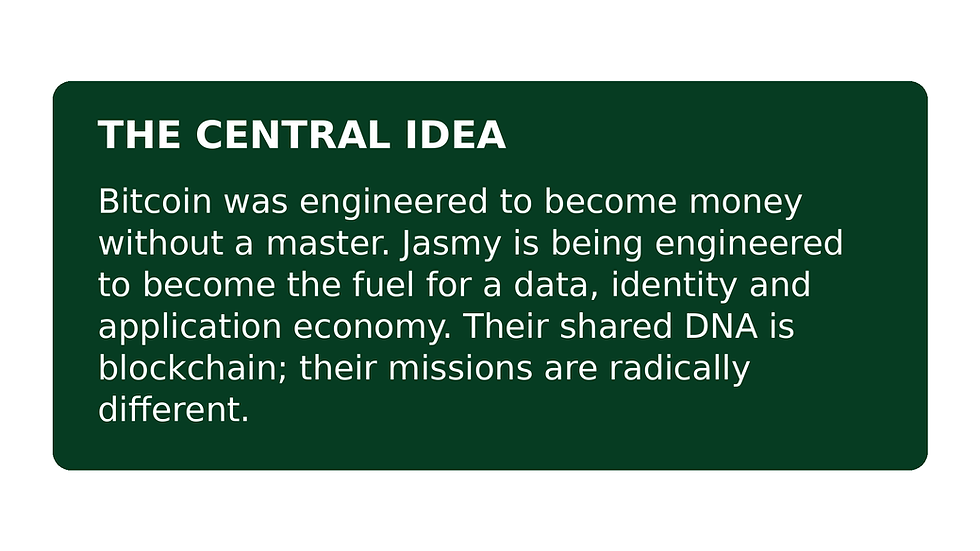
One title. Two very different revolutions
JASMY, the 'Bitcoin of Japan'. It is a thrilling phrase. It is also a phrase that can mislead if it is taken too literally. Bitcoin was built to answer one historic question: can two people exchange scarce digital value without asking a bank, government or company for permission? Jasmy begins somewhere else. It asks who should control the data produced by our phones, computers, vehicles, identities and connected devices - and who should benefit when that data becomes valuable.
Picture the two systems as revolutions approaching the digital economy from opposite directions. Bitcoin begins with money and strips away the intermediary. Jasmy begins with personal data and tries to return control to the individual. Bitcoin protects a scarce asset. Jasmy wants to connect identity, consent, data, enterprise services and payments so that digital activity can become an economy in its own right.
That distinction matters because JASMY should not be judged by asking whether it can replace Bitcoin. The more interesting question is whether Jasmy can build useful infrastructure in areas Bitcoin was never designed to serve.
Bitcoin versus Jasmy: the clearest comparison
The table below separates the marketing shorthand from the underlying machinery. Bitcoin is the more decentralised, scarce and proven monetary network. JasmyChain is the more programmable system, with a much broader intended role across data, identity and enterprise applications.

Bitcoin's superpower: credible neutrality
Bitcoin is powerful partly because it refuses to do too much. It does not know your name, verify your employment, store your health data or decide which enterprise application you may enter. It records ownership and transfers of bitcoin according to rules that thousands of independent participants can verify for themselves.
There is no Bitcoin Corporation that can redirect the project, promise a partnership or rewrite the monetary policy. Its maximum supply is embedded in a consensus system that is deliberately difficult to change. That slowness can be frustrating, but it is also the source of Bitcoin's credibility. People do not need to believe a management team will execute a roadmap; they need to believe the network will continue enforcing its rules.
This is why Bitcoin's utility can look narrow while remaining enormous. A neutral, globally transferable bearer asset does not need hundreds of applications to justify its existence. Being dependable digital money is the application.
Jasmy's superpower: programmable utility
Jasmy is attempting something more complicated. Its Personal Data Locker is designed to let an individual control access to personal information. Decentralised identity can support authentication. Enterprise applications can request verified information or user permission. JasmyChain can execute tokens and smart contracts, while JASMY supplies the gas needed to process activity on that network.
The production JasmyChain is an Ethereum-compatible Layer 2 built with Arbitrum Orbit and the Nitro stack. This gives developers access to familiar Ethereum tooling while aiming for faster and cheaper transactions. Instead of ETH, JasmyChain uses JASMY as its custom gas token. A transfer, contract interaction, token launch or application event can therefore create a small but direct requirement for JASMY.

That transforms JASMY from a token that can be used for value exchange into a token with structural network utility. But the scale of that utility will be determined by activity. Cheap gas is excellent for users; economically, however, very low fees require a large volume of genuine transactions before they become significant.
How Jasmy’s utility can become a self-reinforcing engine
The Jasmy thesis becomes exciting when its components stop being separate products and begin feeding one another. Verified identity can open a Personal Data Locker. The locker can support enterprise applications. Applications generate transactions. Transactions require gas. A more useful network can attract more developers, organisations and users.
This is where the 'Bitcoin of Japan' label starts to undersell the ambition. Bitcoin created a network effect around ownership of money. Jasmy is trying to create a network effect around ownership of identity and data, with JASMY acting as the connective economic layer.
Why more utility does not automatically mean more value
A token can have ten advertised uses and still produce less economic demand than an asset with one compelling use. Utility matters only when it is repeated, necessary and difficult to bypass. A company announcement is not demand. A pilot is not demand. Even a functioning blockchain is not meaningful demand if transaction volume remains negligible.
For JASMY, the key question is not whether gas exists; it does. The question is whether enterprises and users will generate enough sustained activity to make holding, acquiring and using JASMY operationally necessary. Gas consumption could contribute, but the stronger model would combine gas with settlement, application access, rewards, liquidity and other forms of recurring ecosystem use.
Supply also needs to be understood correctly. Bitcoin's roughly 21 million maximum supply and JASMY's 50 billion-token contract supply cannot be compared by looking at the price of one coin. A token with more units is not automatically cheaper or less valuable. Market capitalisation, circulating supply, liquidity and genuine demand determine the economic result.
Where Bitcoin wins - and where Jasmy could surprise
Bitcoin wins decisively in decentralisation, security history, monetary credibility, liquidity and demonstrated global adoption. Jasmy is not close to Bitcoin on those measures, and pretending otherwise weakens the case for Jasmy rather than strengthening it.
Jasmy's opportunity lies elsewhere. It can support programmable applications that Bitcoin's base layer deliberately avoids. It can connect verified identity with user-controlled data. It can target IoT and machine activity, where high-frequency, inexpensive transactions matter. It can work with enterprises and regulated services that need more context than a pseudonymous payment address can provide.
In other words, Bitcoin is stronger wherever neutrality is the product. Jasmy could become stronger wherever controlled data, identity, permission and application logic are the product.
So is JASMY really the 'Bitcoin of Japan'?
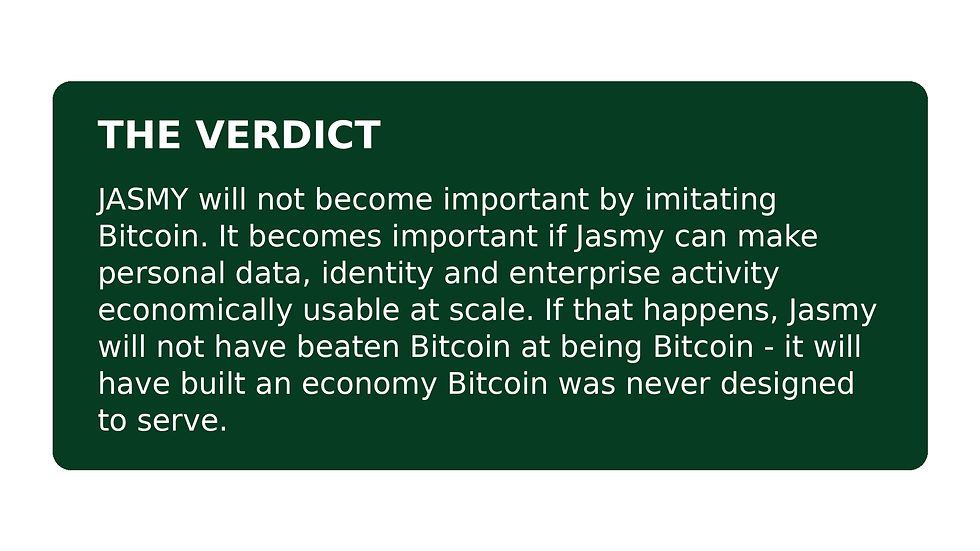
Not technically. BTC is the native monetary asset of an independent proof-of-work Layer 1. JASMY is an Ethereum-origin utility token that now powers an EVM-compatible Layer 2 and sits within a company-led data ecosystem. Their architectures, governance, trust assumptions and economic purposes are fundamentally different.
But the nickname still captures something emotionally important. Bitcoin became a symbol of digital ownership: if you control the keys, you control the asset. Jasmy is trying to extend that instinct from money to the rest of digital life: if the data describes you, perhaps you should control the permission, the access and the value it creates.
That is a much more exciting proposition than simply creating another Japanese cryptocurrency. Bitcoin asked: what if money no longer needed a bank? Jasmy asks: what if identity and personal data no longer needed to belong to a platform?
What next?
The evidence to watch is measurable rather than rhetorical: sustained growth in genuine JasmyChain users and transactions; enterprise applications that name Jasmy and move beyond demonstration; PDL-linked services with active users; recurring JASMY gas or settlement demand; and transparent confirmation that ecosystem participation requires the token rather than merely placing it in the background.
Until those indicators appear at scale, Bitcoin remains the proven monetary network and Jasmy remains the ambitious utility network. That gap is the risk - but it is also the source of the opportunity, and what a massive opportunity it is!



Dobrze zaprojektowana edukacja zdalna może być równie skuteczna jak tradycyjna nauka, pod warunkiem że materiały są odpowiednio uporządkowane i angażujące. Krótkie lekcje, ćwiczenia, testy oraz materiały dodatkowe pomagają utrzymać regularność nauki. Ważne jest również umożliwienie uczniom samodzielnego kontrolowania postępów. Strona poświęcona metodom nauki online mogłaby być pomocna zarówno dla uczniów, jak i nauczycieli przygotowujących własne kursy.
Współczesne technologie informatyczne rozwijają się bardzo szybko, dlatego materiały edukacyjne powinny koncentrować się nie tylko na konkretnych narzędziach, ale także na podstawowych zasadach działania systemów. Artykuły o programowaniu, sieciach, bazach danych, bezpieczeństwie oraz chmurze mogą tworzyć solidną bazę wiedzy. Szczególnie wartościowe są poradniki zawierające praktyczne przykłady, dzięki którym czytelnik może samodzielnie przetestować omawiane rozwiązania.
Profesjonalne szkolenie pilotów wymaga połączenia wiedzy teoretycznej, praktyki oraz bardzo dobrego przygotowania do sytuacji nietypowych. Materiały edukacyjne dotyczące aerodynamiki, meteorologii, nawigacji oraz procedur lotniczych mogą być interesujące również dla osób, które dopiero rozważają rozpoczęcie nauki. Warto byłoby stworzyć przejrzystą bazę wiedzy przedstawiającą kolejne etapy szkolenia, wymagania oraz podstawowe pojęcia związane z lotnictwem cywilnym.
Tematy związane z logistyka i transport mają duże znaczenie dla współczesnego biznesu, szczególnie przy rosnącym znaczeniu handlu internetowego i międzynarodowych łańcuchów dostaw. Edukacyjne artykuły mogą wyjaśniać zagadnienia magazynowania, planowania tras, zarządzania zapasami oraz optymalizacji kosztów. Warto również przedstawiać konkretne przykłady pokazujące, jak technologie i analiza danych pomagają usprawniać procesy logistyczne w małych i dużych przedsiębiorstwach.
Rozwijanie kreatywne umiejętności może być przydatne nie tylko w zawodach związanych ze sztuką czy projektowaniem. Kreatywność pomaga również w marketingu, biznesie, edukacji i rozwiązywaniu codziennych problemów. Dobry serwis edukacyjny mógłby publikować ćwiczenia, przykłady projektów oraz praktyczne materiały dotyczące projektowania, pisania, tworzenia treści i pracy z narzędziami cyfrowymi. Szczególnie ciekawe byłoby pokazanie całego procesu od pomysłu do gotowego projektu.